Showing posts with label Manuel Antonio. Show all posts

Monday, January 23

Butterflies and crocodiles

The sun comes up early here and it was already high and hot by the time we reached the Manuel Antonio Nature Park, part of a 25 acre private wildlife refuge. The big attraction here is the butterfly garden but several tours are offered, including a night walk to see the over-a-dozen species of frogs and toads. Since it was 10 in the morning we opted for a more mundane experience.

Our first stop was the butterfly atrium where our knowledgeable guide tried his best to pound "A Complete Guide to Butterflies: Their Lives, Habits and Habitats" into our overheated brains. It was a hopeless task but a remarkably beautiful little garden, utterly fascinating information, and an hour well spent. But don't expect me to tell you which butterfly has four legs and which six.


Our expert guide about to point out a spider web so strong
we could pull on it without breaking or tearing it. So strong, in fact, that the natives
 used to roll them between their palms into long strands, wind several strands
together, and use them for fishing lines. The spider was pretty hefty too.


You'll have to click on these photos to appreciate the remarkable insects.


I love this little guy. 

There were about five kinds of butterflies in the garden.
The variety changes depending on their life cycles.


These big ones are Blue Morphos (Morpho peleides), a Costa Rica icon.
They fly a quick, irregular pattern so were hard to capture with the camera.

The view through the microscope shows the wings are covered with scales,
much like a snakeskin.

• 


On to the crocodiles. This is a young female.
Many of these are rescued and may be released back into the wild.
Crocodiles are seriously nasty and can run up to 25 MPH for short distances.
If you are ever being chased, remember to run a zigzag pattern;
they have a hard time turning quickly. 

And watch out for those teeth!

This is a cayman, smaller than a crocodile and not so aggressive. 

A prehistoric tail.

A male and female turtle. Can you tell the difference? Neither can we.

This is a box turtle (I think). There were several kinds in the ponds including
snapping turtles, which can take a finger off—or a hand if they're big enough.


We leave Manuel Antonio in less than a week and have seen only a fraction of the abundant flora and fauna that makes Costa Rica famous, but that fraction includes kingsized editions of every houseplant I've ever tried to grow or thought of growing; two kinds of monkeys (and another frequently heard) numerous iguanas and other lizards, black squirrels, many mostly unidentified birds, a small brown rodent in the "back yard," a poisonous viper in a jar, and four three-toed sloths. 

(Costa Rica has both three- and two-toed sloths. A local described them thus: the three toed sloth is a vegetarian and has a smile on his face; the two-toed eats insects and wears a frown. The inference is clear.)  Our visual inventory must also include the four kinds of ants, big brown beetles and two geckos that share our apartment. 

We will miss everything but the ants. 


Photography copyright by Ray Gilden, 2012


Tuesday, January 17

Zipping down winding up

Manuel Antonio is the perfect destination for people who love resort-style entertainment. Here's a sample of ads in the monthly magazine Quepolandia (a free guide to the area):
  • Sport fishing and spear fishing
  • Jet skiing
  • Parasailing
  • Horseback riding
  • Whitewater rafting
  • Mangrove island boat tours
  • Snorkeling
  • Sunset sailing tours
  • Guided tours to the park and other forests
  • Surf boarding and lessons
  • Canopy tours (zip-lining)
To help you recover from all that activity there are spas and yoga salons, infinity pools, beaches, bars, and restaurants. Of course MA isn't alone in offering all this, but unlike other resorts we're familiar with (Cancun and Ixtapa come to mind) they have done a good job of protecting their environment. No high-rise hotels hug the shoreline, and new developments must set aside some nondeveloped land. 

Costa Rica is rightly proud of its green reputation, which supports a tourist industry that employs a great many people. I'm guessing that most of the working people in this town are connected in some way with tourism—not a risky guess since we see them going to and from work wearing shirts with the logos of hotels, tour companies, restaurants and bars. 

We couldn't miss out on all this fun so last week we went zip-lining. A minibus picked us up at 7:15 a.m. and carried us out of town to La Foresta Nature Resort, 180 acres of primary and secondary rainforest reserve. After checking in at the office we met our guides, Luis and Ronald, and the fun began. (But not before visiting briefly with an Alaskan man with his foot in a cast. When we asked how it happened he said, "Zip-lining—but not here." Oh good.)


Here's one of the platforms. Sometimes climbing up to these was more
 frightening than the zipping.


After the tour we sat down for breakfast, then took a walk
around the grounds. I liked this tree.

Here's Ray on a long suspension bridge.

The open-air dining room. We were lucky to be the only ones on
the tour that morning and we could relax and take our time. After Luis reported
  there had been forty people the previous afternoon, we realized how lucky. 

We took our after-activity relaxation a few days later and had
breakfast at the Mariposa hotel, a lovely place with a more than
 180-degree-view from the terrace dining room. (Rooms here start around $250.)

The Pacific was calm and hazy with humidity.

The buffet breakfast was delicious, and the tables uncrowded.
No one here rushes anything so we took our time and enjoyed the scenery.

The peninsula is part of Manuel Antonio National Park. You can see
 that although hotels and homes are present, the view
is unblocked by high rise hotels.


There are a few more things on our to-do list but time is getting short. We're down to 12 days, and honestly, we're counting them. We're ready to get back to family, friends, and our new house; to gather up our belongings, now scattered across five towns, and to get started on the next chapter in our lives.

A few minutes ago Ray called me away for our late afternoon walk. We turned left onto the now familiar road and headed downhill, saying "hola" numerous times and patting many familiar dogs. I waited while he tossed a frisbee with a little boy and then we followed the U left, through the shady jungle trees and up the hill toward the highway. Just past the U we heard the calls of howler monkeys. We've never managed to see them, but we hear their calls—which sound like roar—often. (I can hear them as I write.)

Up the hill now, the road almost disappearing into graveled chaos; more "holas." There are the bantam roosters, here are more dogs to pet. We look for the leaf-cutter ants but can't find them. We stop to watch children kicking a soccer ball around the town field, then turn left again along the highway, cursing the diesel truck and a roaring motorcycle, searching for sloths in the trees near the bus stop, waving to hard-working Khang in his restaurant. Left again at the market, one more greeting from a now familiar Tico, and here we are at home.

There are definitely things I will miss about Manuel Antonio.


Saturday, December 31

Pura vida

A column in today's New York Times, "The Joy of Quiet" by Pico Iyer, reminded me that our intention in coming to Costa Rica was to enjoy a few months of quiet. We have not found that, though it seems unimportant now; we have grown accustomed to the daily sounds surrounding us. Iyer's focus is about saving silence and quiet time for children, but all of us who depend on the Internet and electronic devices already know we are losing something inestimable.

We rely heavily on the Internet here, for communication, news, and entertainment. Ray uses a laptop and I use my iPad. An iPod is plugged into portable speakers through which we hear music and news. Photographs are electronic and can reach the world in a few seconds. This is all good, and helpful in its way. But it is a far cry from true silence, a gift that was with us from the beginning and should be still. Now we are lucky if we recognize scattered increments.

"Listen!"

"To what?"

"Nothing."

Because our house is right next to a worn and pot-holed road and a speed bump, we hear, not cars and trucks driving smoothly past, but cars and trucks braking, driving through a gravel patch to avoid the bump, and bouncing over the bump. We hear the merchandise headed to the little living-room grocery down the road slamming and bouncing in the truck beds (the trucks are nearly as big as the shop). We hear souped-up cars scraping bottom and motorcycles accelerating across it.

Other daily sounds include the footsteps of our upstairs neighbors, the crying of the teething baby next door, the voices of conversations and calls up and down the street, the pounding rain, the barking dogs, the occasional singing of Dago, our neighbor, and when we're lucky, bird calls. In the depths of my illness I slept through it all and now it's part of my life and seldom noticed. It's also part of the culture we came to explore and thus easier to accept. ("Different culture, different customs.")

As a writer, I've always found describing sound a difficult chore. Onomatopoeia, words that suggest the sound they describe (cackle, boom, tinkle) do good work but they lack that missing element, the effect noise has on the human body. For we hear not only through our ears. Our entire body reacts when a truck bounces over a speed bump 20 feet away, or firecracker goes off unexpectedly outside the window. Our heart pounds, our nervous system twangs, our brain orders a shot of adrenalin. Even when we don't acknowledge the sound, don't hear it out of custom, our body hears it and filters it and reacts to it. Sometimes it replays, altered, in dreams. That's hard to capture in one short sentence.

Fortunately, firecrackers don't often explode outside our windows, but the constant drone of ever present noise, even when it comes from YouTube or an iPod, has a wearing affect on the body. Finding silence is one of the best things you can do for yourself, and though we misjudged its presence here, we'll never stop pursuing it. Maybe 2012 will be the year.


***

The convenience of instant communication did make it easier to meet up yesterday with an old friend from San Francisco. Robert and I worked together in the News and Publications office at Reed College when he was a student there in the early 90s. Robert stayed on after graduation to work for a year on a fundraising campaign and we occasionally commuted together. We lost touch about ten years ago and reconnected through Facebook (much as I dislike it, it does have its uses). Yesterday we had lunch together at Cafe Milagro and caught up with news of family and friends; it was though we'd spoken only a week ago.


Ray, Karen, and Robert


Back at home we had a bit of excitement when we heard a new and surprising noise. Three motorcycle policeman chased a wayward driver down our road, sirens blaring. Naturally we went out to look so we were handy when Daniel, one of the officers, came over to ask for two glasses of water, please. We watched as the car was moved and searched and we waited while the young officers stood around and flirted with young women passing by. Finally the traffic truck came and issued a ticket—or something, and Daniel returned our glasses and the excitement was over.


A motorcycle policeman and supervisor await the traffic truck.
(The suspect's white car is in front of our house.)


Daniel and Ray share a smile.

Before he left Daniel carefully wrote his email address on a piece of paper so Ray could send him a photo. Then he put an arm around each of us and speaking in broken English said very seriously, "Life is good. And the world is small." 


Pura vida is difficult to translate; the closest is "plenty of life." You see it everywhere here, on teeshirts, caps, paintings and pottery. People have said it to me on the street, always accompanied by a big smile. It's used to express many things but I like to think it's what Daniel was trying to say. Life is good, and we're all in it together.

May 2012 bring you everything good you can wish for, and may it bring all of us—together—peace, contentment, and a little bit of silence.

Pura vida!


Wednesday, December 28

A little diversion

Since I frequently mention our daily walk I thought I'd post some photos of what we see. A little diversion while we continue to get well. 


This was taken about half-way down the hill from our door, looking toward the curve of the U, which turns left into never-ending shade. The road here is always wet and muddy and the only house seldom sees sunlight. A boy about 12 usually lounges on the balcony so we stop and visit. He speaks good English and says his favorite subject is math. A few days ago we asked what he was doing with his vacation (school is now out until March) and he shrugged. So I said, "Swim?" Yes. "Surf?" Yes. "Football?" Yes. Always with a big smile. After that we could only agree that if he likes those things he lives in a good place.


Every Tico family seems to have at least one dog; most have two or three. They're usually mutts about knee high, short-haired and friendly. We seldom see cats, but this kitten caught Ray's eye.


Ray climbed up a fence to capture this photo of a house behind high walls. This is on the downhill leg of the U.


Here's a typical Costa Rican dog, looking a little lonesome.


This is coming up the hill toward the highway. The dense green behind me is the shady curve of the U.


Cafe Milagros isn't on our walk, but it's one of our favorite MA places and it's where we hung out during the rain, mentioned in an earlier post. Good fruit smoothies!


Sancho's is another favorite eatery, known for its fish tacos—the best yet.


Marshall, the owner, is an American expat.


Susan and Khang are recent additions who moved from Tampa to open a Vietnamese restaurant. They arrived in December and are already doing a good business. Their take-out restaurant is between the two ends of the U along the highway so we see them often. And when we're too lazy to cook we let them do it.


Back at home, and I can't resist including recent views from our window. Unfortunately, I can't say what kind of bird this is because the paperback guide to Costa Rican birds was $70 which, like many prices here, seemed excessive.


This little guy looks very comfy in the center of the banana tree.


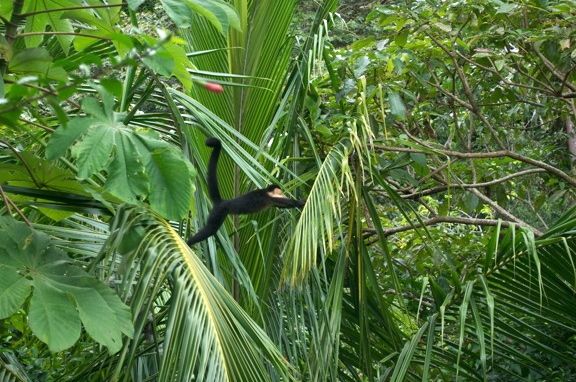
We're always trying to get photos of the monkeys in action. So far this is the closest we've come.


Here's mom and baby trying for some food. 


The last time the monkeys visited, someone at our neighbor's house was feeding them bananas—a big no no of course—and it made them braver than usual. This little guy is right next to our window.

Okay, time for a nap.


Monday, December 26

Christmas in Costa Rica

I've been neglecting you lately and the excuse is, I've been sick. Don't worry, I won't bore you with details; I know you don't want them. Being sick is a singularly lonesome exercise. It's a little like death, which is often wished for. In this case Ray also picked up my ailment so we've been suffering in unison—we even cough in unison occasionally which is very entertaining. The fact that it's entertaining tells you something about our lives at the moment. But, I promised I wouldn't go there.

Frankly, I can't tell you much about Christmas in Costa Rica. It's probably different in the capitol, and larger cities, but in our little Manuel Antonio neighborhood there's not much going on.


A man builds bamboo chairs in front of a rare Christmas tree.

Traditionally, we're told, Costa Ricans celebrate the holiday rather simply. There might be music or parades a few days before, but Christmas Eve is a time for church and family, and a traditional after-mass supper of tamales and other favorites. I can assure you that loud fireworks are popular. Santa is not a dominant figure and we didn't see a single picture of him here, or even much in the way of decorations. Instead, children put their shoes out on Christmas Eve and if they're lucky the Christ Child fills them with presents.

We spent Christmas morning in a Skype conversation with the Gilden-Holmes family watching them unwrap gifts and eat sticky buns and chocolate Santas. That proved a little over stimulating so we both took naps and then walked our U-loop to see what holiday celebrations we might detect. Except for a couple of tipsy beer drinkers there were exactly zero signs of the holiday. No children played in the road with new toys, no adults sported new clothes. Clothes did dominate the view though, because the local housewives took advantage of the sunny morning to do laundry, and it decorated lines, tin roofs, and shrubbery all along our route.

Along the highway only two small eateries were closed, both owned and run by Americans. The big hotels and high end restaurants did of course have decorations and elegant holiday dinners planned, and I'm sure the tourists who flock to this part of Costa Rica for the holidays—it's the busiest week of the year—enjoyed it all immensely. Since neither of us could taste anything, we passed.

We are getting better though. Today we managed the walk twice and my taste buds magically came to life in time for fajitas last night. They weren't good fajitas, but still, when all you've been able to taste for two weeks is vinegar, anything is a blessing. That it occurred on Christmas Day I took as a sign.

We both wish you all the joys of the season, including that most important ingredient, good health. We intend to join you in that any day now.


Sunday, December 4

A walk to the beach

There are several beach coves along the coast that stretches from Quepos to Manuel Antonio National Park. The one nearest our house is Rocky Beach, so about a week ago we took an exploratory walk to see what it was like. We went early to avoid the heat.

Our first view of the sea. The road down passes through a private resort
but the beach itself is open to all.

Ray checks a stand of bamboo.

Near the bottom of the hill are a couple of deserted buildings that
demanded exploration. We're told they are deserted homes.

The coast itself looks much like Oregon's;
 just swop the tropical trees for firs and spruce. 


Surprisingly, the beach was deserted except for a couple from the resort.
At low tide you can walk from one cove to another
along this stretch, but our timing wasn't right.

This beached log was covered with tiny hermit crabs,
who scurried away when we approached. These are the slowpokes.

The walk back about 10:30 a.m. was hot, humid, and hard, the road being very steep in several places. An old pickup carries the resort residents and their lounge chairs down and up the muddy, bumpy track but we were satisfied to be walking despite the effort. It's a nice beach and we'll definitely go back, taking our suits next time.

Unfortunately, our explorations were curtailed this week, for as soon as I recovered from my cold Ray developed a case of flu (this is day 4 and he's feeling a little better). The weather is improving though, with the rains coming far less often. Sometime soon we will hire a guide and visit the National Park. With his help we should spot lots of wildlife—I'm really hoping for a sloth.


Wednesday, November 30

It's a beautiful day in the neighborhood


The dog next door doesn't bark at night, which is a blessing, but during the day he barks at everyone who walks by. And a lot of people walk by. In the morning they're going to work, in the afternoon returning, and in between they walk to the store on the corner, walk to visit friends, or simply walk and talk—or sing. Thanks to Fido we know when everyone goes by and I'm sure someday we'll appreciate it.

Despite Manuel Antonio being a popular upscale destination, it won't surprise you to learn we're not in luxury accommodations surrounded by deep jungle with a view of the Pacific. Instead, we're in a  studio apartment in a Costa Rican neighborhood (or, as the locals would say, a Tico neighborhood). It's a street of middle class and poorer homes, most with tin roofs like ours. The house two doors down has three floors and a swimming pool and between it and us is a tin shack owned by an American slumlord and rented to a Nicaraguan family. You might say it's a street in transition. And come to think of it, the word street may mislead you. Let's call it a road.

The road (there are no road names or house numbers) begins at the highway next to the Super Joseth and follows a U-shaped route down an incline and around the end of a shallow green-filled canyon, then up again back to the highway. It is narrow, rough, and potholed and because of the rains usually muddy. It's noisy. There are no sidewalks and the houses crowd the road. But there are flowers and greenery and sometimes monkeys, and we like rubbing shoulders with the locals.

Our ground floor studio consists of one large room with tiled floor, a tiled bath and shower, a hall with storage, and a small kitchen with a four-burner electric range we're still struggling to cook on. Used to gas, we find it impossible to gauge cooking temperatures. We have two big rear windows looking out onto jungle (I took the banner photo, above, through one of them) and two looking onto the street, which gives us a nice cross breeze. We have air conditioning, as yet unused, and an overhead fan. Our landlords, Rodney and Eric, are super. We considered the upstairs studio, with a balcony view of the Pacific and a bit more charm, but the kitchen has only a hotplate and microwave and for a ten-week stay that just won't cut it. Besides, we'd have to give up our jungle view; we already know the Pacific.

Like all Costa Ricans our neighbors worry about security so every house has bars at the windows and most have wire fences and big locking gates, as does ours. Violent crime is not a problem here, but theft is; mostly, we're told, thefts of convenience. The bars and the fencing feel like overkill and we find it ugly and a nuisance to deal with, but nobody asked us. Shops, of course, have the same disquieting barriers.

It's much too early to make definitive statements about life in Costa Rica but so far we've found the natives friendly and helpful, but not especially curious or outgoing. And as Rodney told us the first day, "they're not service oriented." So far our limited experience reflects that.

Most of our shopping takes place down the hill in the town of Quepos, a more typical, less touristy town with some decent restaurants and lots of small shops along ragged streets. There's a Pali supermarket with lower prices than the nearby Joseth and a far larger inventory; the bus (25 cents each) stops right outside.

A fair number of American expats live in the two communities and we've already met a number of them. They're friendly and curious about our stay here and willingly answer questions. Unlike the many British expats we met in France, who seemed to hate France and/or the French, these Americans claim to love Costa Rica and many have been here for years.

Dina, at Jungle Juice

We met a lovely Costa Rican woman yesterday, in a juice shop she and her cousin and his girlfriend own together. Called Jungle Juice, it's a clean, modern place with wonderful smoothies of every imaginable flavor and—ta da!—French crepes. It's near the bus stop in Quepos and we're sure it will be a regular stop. Dina, who's originally from San Jose, speaks English like an American and gave us all kinds of tips about where to eat, drink, and visit. On Sunday she's participating in a local triathalon and we hope to be there to cheer her on. I'm sure Fido will wake us in time.